AI Agents in 2026: How They Work and What They Can Do
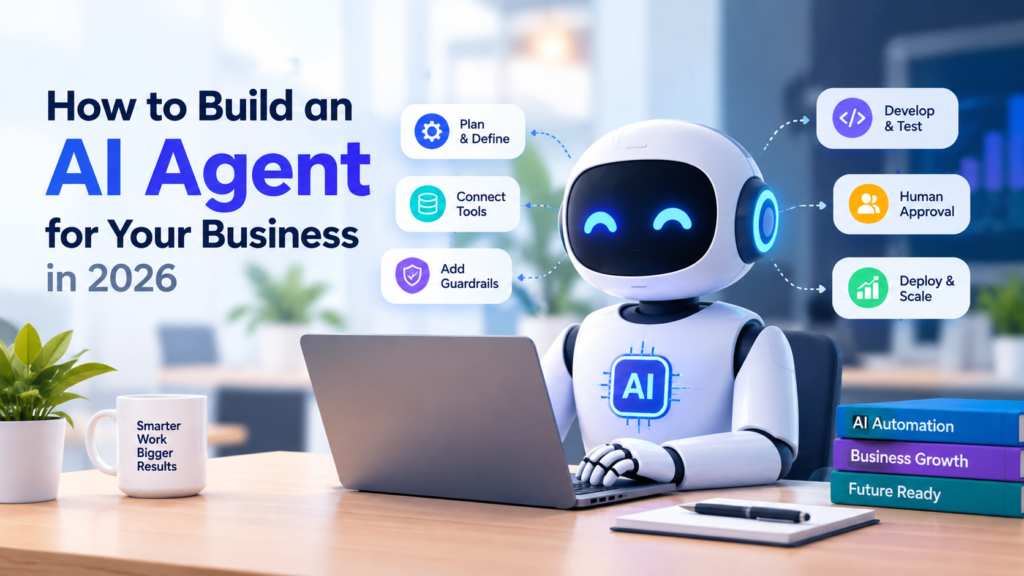
AI is moving beyond systems that simply answer questions.
In 2026, one of the biggest developments in artificial intelligence is the growing use of AI agents—systems designed to reason through tasks, use tools, retrieve information, and take actions toward a defined goal.
The shift is significant because traditional AI interactions often require a person to provide instructions at every step. AI agents are designed to handle more of the workflow themselves, within boundaries established by people and organizations.
But what exactly are AI agents? How do they work? What can they actually do, and where should businesses use them?
What Are AI Agents?
An AI agent is a software system that can pursue a goal by interpreting information, deciding what to do next, using available tools, and taking actions within defined boundaries.
A useful way to understand an AI agent is to compare it with a traditional chatbot.
A chatbot might answer:
“What is our return policy?”
An AI agent could potentially do more:
“Check this customer’s order, determine whether it qualifies for a return, review the applicable policy, prepare the next step, and escalate the case if approval is required.”
The difference is not simply that the agent can generate better text. The important difference is that an agent can participate in a multi-step workflow.
AI Agents vs. Traditional Chatbots
| Traditional Chatbot | AI Agent |
|---|---|
| Primarily answers questions | Can complete multi-step tasks |
| Usually conversation-focused | Workflow-focused |
| Limited system access | Can use connected tools |
| Often provides information | Can retrieve information and take actions |
| Human completes many next steps | Agent can complete approved next steps |
Not every business needs an AI agent. If a simple chatbot, search system, or conventional automation can solve the problem, adding an agent may introduce unnecessary complexity.
How Do AI Agents Work?
At a high level, an AI agent follows a cycle of understanding, planning, acting, observing, and adjusting.
A simplified AI agent workflow looks like this:
Goal → Understand → Plan → Use Tools → Observe Results → Adjust → Complete Task
For example, imagine an employee asks an AI agent to prepare a weekly sales report.
The agent might:
- Understand the request.
- Identify the required data.
- Access an approved sales database.
- Retrieve the relevant information.
- Analyze the results.
- Identify important changes.
- Prepare the report.
- Return the completed report to the employee.
The agent can adapt its actions according to the information it encounters.
The Three Core Parts of an AI Agent
Most practical AI agents can be understood through three important components.
AI Model
The model provides the reasoning and language capabilities.
It interprets instructions, understands context, generates responses, and helps determine what action should happen next.
Tools
Tools allow the AI agent to interact with systems outside the model.
These might include:
- Databases
- APIs
- Search systems
- CRM platforms
- Calendars
- Internal knowledge bases
- Business applications
- File systems
Without appropriate tools, an agent may be limited to generating information rather than completing useful actions.
Guardrails
Guardrails establish boundaries around what an agent can and cannot do.
They can help control:
- Data access
- Tool permissions
- Sensitive actions
- Human approval
- Output quality
- Security requirements
- Escalation conditions
This becomes increasingly important as AI agents receive access to business systems and are allowed to take actions.
What Can AI Agents Actually Do?
The potential AI agent use cases are broad, but the strongest applications generally involve structured, multi-step tasks.
Customer Support
An AI agent can potentially classify customer requests, retrieve account information, search approved documentation, draft responses, and escalate unusual cases.
The human support team can then focus on issues requiring judgment or personal attention.
Sales
AI agents can support sales workflows by researching accounts, organizing information, preparing meeting briefs, updating records, and helping qualify leads.
The agent does not have to replace the salesperson. It can handle repetitive preparation work so the salesperson can spend more time on customer relationships.
Software Development
Software development has become one of the visible areas for agentic AI.
An AI coding agent can work through longer tasks such as examining a codebase, making changes, running tests, identifying errors, and revising its approach.
Research and Analysis
An AI agent can help with multi-step research by gathering information from approved sources, organizing findings, comparing information, and producing a structured result.
Human review remains important when the information affects important business, financial, legal, health, or safety decisions.
Business Operations
Organizations can also use business AI agents for repetitive internal processes.
Examples include:
- Document processing
- Internal knowledge retrieval
- Reporting
- Scheduling
- Procurement support
- Data analysis
- Workflow coordination
What Are the Benefits of AI Agents?
The potential AI agent benefits extend beyond saving time.
Increased Productivity
Agents can take on repetitive tasks that previously required employees to move between applications, search for information, and perform routine operations.
Longer-Horizon Work
One important difference between traditional AI assistance and agentic AI is the ability to work through longer tasks.
Instead of requiring a person to provide a new instruction after every step, an agent can potentially continue working toward a defined objective.
Better Workflow Automation
Traditional automation generally follows predefined rules.
Agentic systems can introduce more flexibility because the AI can interpret information and determine actions within a defined workflow.
More Scalable Operations
A well-designed agent can potentially handle repeated digital tasks without requiring an employee to manually initiate every step.
However, scalability depends on reliability, infrastructure, permissions, monitoring, and appropriate governance.
What Are the Risks of AI Agents?
Greater autonomy creates greater responsibility.
An AI agent that only generates a draft has limited authority. An agent that can modify records, send messages, access confidential information, or trigger transactions has a much larger risk surface.
Important risks include:
- Incorrect decisions
- Unauthorized actions
- Data exposure
- Prompt injection
- Excessive permissions
- Poor-quality outputs
- Unexpected tool usage
- Lack of human oversight
- Difficulty monitoring complex workflows
The answer is not necessarily to avoid AI agents. It is to design them with appropriate boundaries.
Why AI Agent Guardrails Matter
An autonomous system should not automatically have unlimited authority.
For example, an AI agent might be allowed to:
Read: Customer support documentation.
Analyze: Customer requests.
Draft: A response.
But it may require human approval to:
Issue: A large refund.
Delete: Customer information.
Change: Important account settings.
This creates a human-in-the-loop AI model where the system can automate routine work while people remain responsible for consequential decisions.
Guardrails should be designed around the actual risk of the workflow.
What Is the Future of Agentic AI?
The next stage of agentic AI is likely to involve greater collaboration between humans, individual agents, and groups of specialized agents.
Instead of one system doing everything, businesses may use several agents with different responsibilities.
For example:
Manager Agent
↓
Research Agent → Analysis Agent → Reporting Agent
Another system might connect sales, customer service, finance, and operations agents into a larger workflow.
However, more agents do not automatically mean better results.
Organizations still need:
- Clear objectives
- Reliable data
- Secure tools
- Strong permissions
- Evaluation
- Monitoring
- Human accountability
How Businesses Should Start With AI Agents
Businesses do not need to automate everything at once.
A practical starting point is one clearly defined workflow.
Ask:
- Is the task repetitive?
- Does it involve multiple steps?
- Can success be measured?
- Does the agent have access to the necessary information?
- Can permissions be limited?
- Can a human review high-risk actions?
- Is there a clear business benefit?
If the answer to these questions is mostly yes, the workflow may be a good candidate for an AI agent.
Start small, measure the results, identify failures, and expand gradually.
AI Agents in 2026: What Comes Next?
The biggest change in AI may not simply be better answers.
It may be the transition from asking AI to do something toward delegating work to AI.
This distinction is important because businesses are increasingly looking at AI as a way to support complete workflows rather than individual tasks.
This does not mean every task will become autonomous.
Some work will remain human-led because it requires judgment, accountability, creativity, relationships, or decisions where the consequences of error are too significant for unrestricted automation.
The likely future is therefore not simply humans versus AI.
It is increasingly humans working with AI agents.