AI Search vs Google Search: How Search Is Changing in 2026
Search is changing faster than it has in years.
For decades, the basic search experience was familiar: type a query into Google, receive a list of links, scan the results, and visit websites to find the answer.
That model is now evolving.
AI search can interpret longer questions, combine information from multiple sources, summarize findings, and continue a conversation through follow-up questions. Google’s AI Overviews and AI Mode are examples of how generative AI is becoming part of the traditional search experience.
This raises an important question for businesses, publishers, marketers, and creators:
Is AI search replacing Google Search, or is Google Search becoming AI-powered?
The answer is more nuanced than either option.
What Is AI Search?
AI search uses artificial intelligence to understand a user’s question and provide a synthesized response rather than relying exclusively on a traditional list of links.
A traditional search might return:
- Ten blue links
- Featured snippets
- Images
- Videos
- Maps
- Shopping results
- News results
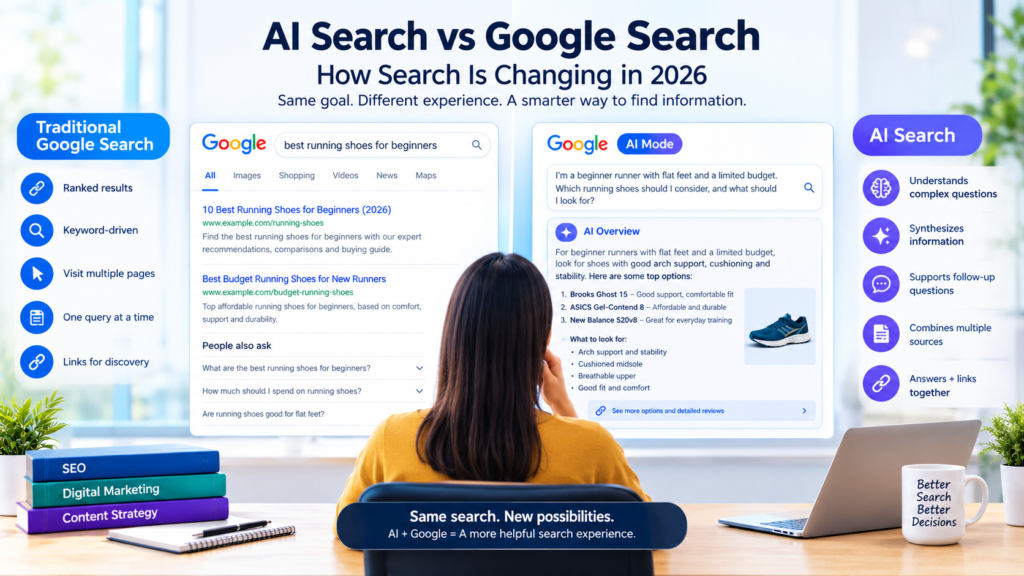
An AI-powered search experience can instead provide a conversational answer that combines information from multiple sources and may include links for further exploration.
For example, instead of searching:
“best running shoes for beginners”
a user might ask:
“I’m a beginner runner with flat feet and a limited budget. Which running shoes should I consider, and what should I look for?”
The second query contains more context and constraints.
AI search is designed to handle this type of more conversational and complex request.
What Is Traditional Google Search?
Traditional Google Search is built around retrieving and ranking information from the web and presenting relevant results to the user.
A typical search journey looks like this:
Query → Search results → Website → Information → Decision
For example:
“How to choose accounting software”
A traditional search might show:
- Product pages
- Comparison articles
- Reviews
- Guides
- Videos
- Forums
- Other relevant resources
The user then decides which results to open and which information to trust.
This model remains useful.
AI does not eliminate the value of traditional search results because users still need original sources, detailed information, product pages, firsthand experiences, and authoritative references.
AI Search vs. Google Search: What Is the Difference?
The biggest difference is how information is presented and how the user interacts with it.
| Traditional Google Search | AI Search |
|---|---|
| Primarily presents ranked results | Can synthesize information |
| Often keyword-driven | Can understand conversational questions |
| User visits multiple pages | AI can summarize multiple sources |
| Usually one query at a time | Can support follow-up questions |
| User performs much of the research | AI can assist with research |
| Links are the main discovery mechanism | Answers and links can work together |
However, these experiences are increasingly merging.
Google is not simply operating one traditional search engine and one separate AI system. AI-powered features are becoming part of the broader search experience.
What Are Google AI Overviews?
AI Overviews are AI-generated summaries that can appear within Google Search when an AI-generated response can help answer a query.
Instead of requiring users to open several pages immediately, an AI Overview can provide an initial explanation and links for deeper exploration.
This changes the search journey.
Previously:
Search → Click → Read → Compare
Now it can be:
Search → AI Overview → Explore sources → Compare → Take action
For content creators and businesses, this means visibility is no longer only about appearing as a traditional blue link.
Content may also become part of the information used to construct an AI-generated answer.
What Is Google AI Mode?
Google AI Mode goes further than a basic AI-generated search summary.
It is designed for more complex, conversational searches where users may ask follow-up questions and explore a topic through multiple stages.
For example, instead of conducting separate searches for:
- Best places to visit in Bengaluru
- Bengaluru weather in December
- Family-friendly activities
- Best restaurants
- Travel time between attractions
a user could potentially ask one detailed question containing all those requirements.
An AI-powered search system can then investigate different parts of the request and bring the information together.
That changes what users expect from search.
How AI Search Is Changing Search Behavior
One of the most important changes is that people can ask more natural questions.
Users do not always need to think about the perfect keywords.
They can explain what they want.
For example, someone might search:
“What is the best laptop under ₹70,000 for video editing, long battery life, and occasional gaming?”
instead of:
“best laptop under 70000.”
The second query is shorter.
The first expresses:
- Budget
- Use case
- Performance requirements
- Battery requirements
- Secondary use
Content that addresses these details clearly can be more useful to the reader and potentially more useful within AI-powered search experiences.
Does AI Search Replace SEO?
No.
But it is changing what effective SEO in 2026 needs to accomplish.
Traditional SEO remains important because search engines still need to discover, understand, and rank websites.
At the same time, AI-powered search creates additional opportunities for content to be surfaced through synthesized answers and conversational results.
Businesses should not abandon SEO.
Instead, they should broaden their approach.
Think of it as:
SEO + useful content + strong sources + clear answers + entity clarity + firsthand value
The objective should be to create content that genuinely helps the reader rather than content designed only to manipulate rankings.
What Is AI Search Optimization?
AI search optimization is the practice of creating content that is easy for both people and AI-powered discovery systems to understand, evaluate, and use.
There is no single guaranteed formula for appearing in an AI-generated answer.
However, several practices can improve the usefulness and clarity of content.
Answer Important Questions Clearly
Give readers direct answers before adding unnecessary detail.
If someone asks:
“What is AI search?”
the article should define AI search immediately.
Do not hide the definition behind several paragraphs of introduction.
Build Topic Depth
A strong article should answer related questions that naturally follow the main question.
For an article about AI search, that could include:
- What is AI search?
- How does it work?
- How is it different from Google Search?
- What are AI Overviews?
- What is AI Mode?
- Does AI search reduce website traffic?
- How should businesses adapt?
This creates a more complete resource.
Use Clear Structure
Use descriptive:
- H1 headings
- H2 sections
- H3 subsections
- Lists
- Tables
- Definitions
- Examples
Clear structure helps readers navigate complex information.
Support Important Claims
AI search does not remove the need for trustworthy sources.
If an article makes claims about market statistics, technology capabilities, regulations, medical information, financial data, or other consequential topics, those claims should be supported by appropriate evidence.
Will AI Search Reduce Website Traffic?
This is one of the biggest questions for publishers and businesses.
The answer is not simply yes or no.
Some searches can be answered directly in an AI-generated response. In those cases, a user may not need to click a website.
For example, a simple factual query may be completely satisfied by a short answer.
But complex searches can create different behavior.
Users may still click through when they want to explore a topic in greater depth, verify information, compare products, read original reporting, or access a specific service.
The practical lesson is important:
Do not build a content strategy around the assumption that every search will produce a website visit.
Create content that provides value beyond a basic answer.
What Should Businesses Do About AI Search?
Businesses should start adapting now, but they should not abandon traditional SEO.
Create Content Worth Citing
Generic content is easier to replace.
Original research, expert insights, firsthand experience, useful data, detailed comparisons, proprietary information, and genuinely helpful explanations can provide stronger reasons for users to visit a website.
Answer Specific User Questions
Build content around real customer problems.
Instead of creating an article simply because a keyword has search volume, ask:
What decision is the reader trying to make?
Then create the most useful resource for that decision.
Strengthen Brand and Entity Signals
AI-powered search needs to understand who created the information and what the business represents.
Make important information clear:
- Company name
- Products
- Services
- Authors
- Experts
- Locations
- Contact information
- Relevant credentials
- Supporting sources
Keep Content Updated
AI search evolves quickly.
So do search interfaces, product capabilities, policies, and user expectations.
Review important content regularly and update facts, examples, links, and recommendations when they become outdated.
AI Search vs. Google Search: Which One Is Better?
There is no universal winner.
It depends on the task.
Use AI Search When You Need:
- A complex explanation
- A comparison
- Brainstorming
- A multi-step research starting point
- A conversational follow-up
- Help understanding a complicated topic
Use Traditional Search When You Need:
- A specific website
- A particular webpage
- A local business
- Current contact information
- An original document
- A specific product page
- Direct access to a source
In many cases, the best approach is to use both.
AI can help you understand the landscape.
Traditional search can help you verify information and explore the original sources.
The Future of Search Is Likely to Be Both AI and Web
The debate is often framed as:
AI search vs Google Search.
But that framing may become less useful over time.
AI can interpret the question and synthesize information.
The web provides the underlying sources, expertise, products, original reporting, data, and perspectives.
That suggests the future of search is unlikely to be simply AI instead of the web.
It is more likely to be AI helping people navigate the web in new ways.
How SEO Should Change in 2026
The fundamentals remain surprisingly simple.
Create content that:
- Answers real questions
- Provides original value
- Uses trustworthy sources
- Demonstrates relevant expertise
- Explains complicated subjects clearly
- Includes useful examples
- Matches search intent
- Is easy to navigate
- Provides information users cannot get from a generic summary
The biggest change is that content needs to be valuable at multiple levels.
A short answer should satisfy a quick question.
A detailed explanation should satisfy deeper research.
Original information should give users a reason to continue to the source.
That is a stronger strategy than trying to predict exactly what an AI system will cite.